
The ENERGAS gas receiving station has been supplied to the Minsk CHPP-5
25 April 2022
The gas treatment equipment will provide the specified design parameters of fuel for the six Siemens SGT-800 turbines which form the basis of peak-standby energy source.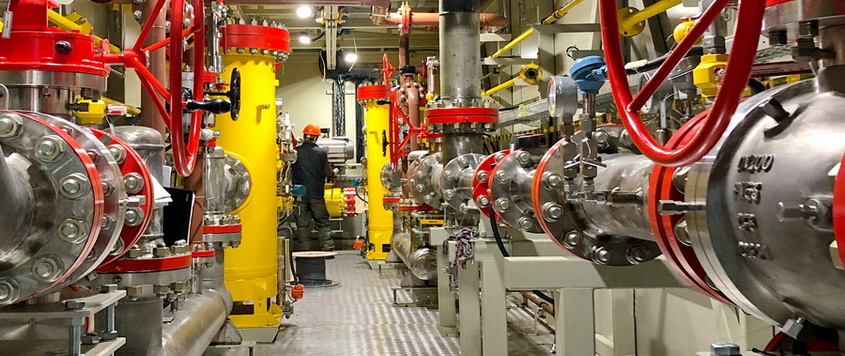
At the Minsk CHPP-5 of RUE Minskenergo, the 300 MW gas turbine power plant (GTPP) based on six Siemens SGT-800 turbines is being created. It is one of four peak-standby energy source (PSES) under construction today for the unified power grid of the Republic of Belarus.
Being in the mode of continued readiness to launch, the facility will maintain, if necessary, the balance of generation and consumption of electricity. The equipment of the new GTPP is characterized by high maneuverability – it will take less than 15 minutes to responsively start and fill the power deficit in the power grid.
Under a contract with Siemens Energy, the Russian Company ENERGAS has equipped a Minsk PSES with a gas receiving station. After workshop tests, GRS has been supplied to the facility in maximum factory readiness that will significantly reduce the duration of the mounting and pre-start works.
The gas receiving station was manufactured by ENERGAS under a special project and is the gas treatment station providing the specified design parameters of the fuel before its feeding into turbines. The main purpose of GRS is purification, flow measurement and heating of gas. The throughput of the station is 87,506 Nm3 / h – similar to the rated fuel consumption of GTPP.
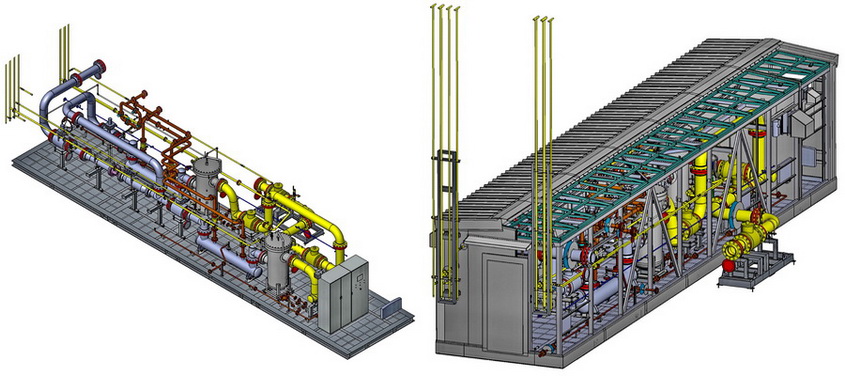
GRS is equipped with a separation system with coalescing filters-scrubbers. The degree of gas purification is 99.9% for impurities over 10 microns in size. It is possible to quickly replace the filter-elements.
To measure the volume of fuel entering the gas-turbine power units, the GRS is equipped with a two-line commercial metering unit with a relative error of no more than 1.5%. Data from him is transmitted via communication channels to the upper level of the automated process control systems.
To achieve design gas temperature (up to +40°C), at the GRS there is installed heating module, which composed of heat exchangers and subassembly of gas condensate gathering and storage with a drainage tank.
The process unit is additionally equipped with fuel quality control subassembly installed on the outlet pipeline and equipped with measuring and analytical equipment.
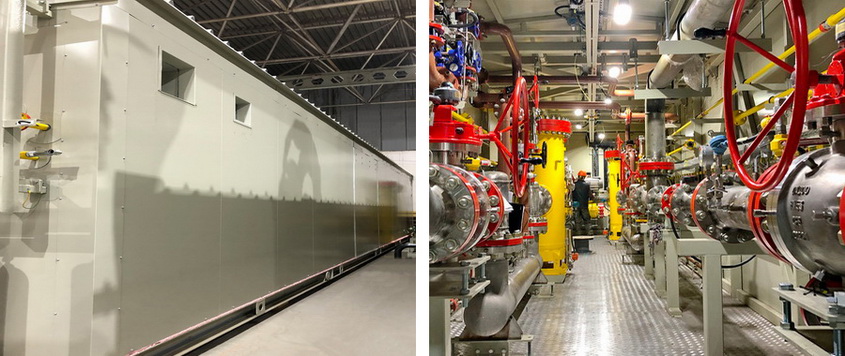
The gas receiving station is placed in a separate all-weather module (block-box) and is equipped with necessary engineering systems, including life support systems (heating, ventilation and lighting) and safety (fire detection, gas detection, alarm and fire fighting).
GRS is fully automated; control will be carried out from the dispatch room of the power facility.
Three more Belarusian PSESs are being created at the sites of thermal power plants of the RUE Brestenergo and Vitebskenergo. At the Berezovskaya SDPP, this is a 250 MW GTPP consisting of five SGT-800 turbines, at the Lukomlskaya SDPP – 150 MW GTPP (of three turbines), at the Novopolotsk CHPP – 100 MW GTPP (of two turbines).
New capacities are aimed at increasing the reliability and flexibility of the Belarusian power grid. Gas-turbine power units will be used as a reserve both for the existing infrastructure and for future wind, solar and nuclear power plants. The commissioning of PSESs will contribute to the decarbonization of the economy and the transition to a new energy structure in Belarus.
The assumed operating time of each peak power facility is approximately 700 hours per year and up to 350 starts from the cold state. The ENERGAS gas receiving stations will also operate here. GRSs will be installed on supply pipelines for filtration, flow measurement and heating of entering fuel gas.
REFERENCE:
Minsk CHPP-5 is the youngest power plant in the Belarusian power grid. Initially, the plant was intended as a nuclear power plant; however, after the accident at the Chernobyl nuclear power plant, construction was stopped. Afterwards, the facility was taken out of preservation and completed as a conventional combined heat and power plant.
In 1999, a steam-power power unit (station No. 1) with an electric capacity of 330 MW was put into operation, and in 2012, a combined-cycle power unit (station No. 2) with a capacity of 399.6 MW.
| Previous news | Back to the list | Next news |